The importance of pollinators in almond cultivation
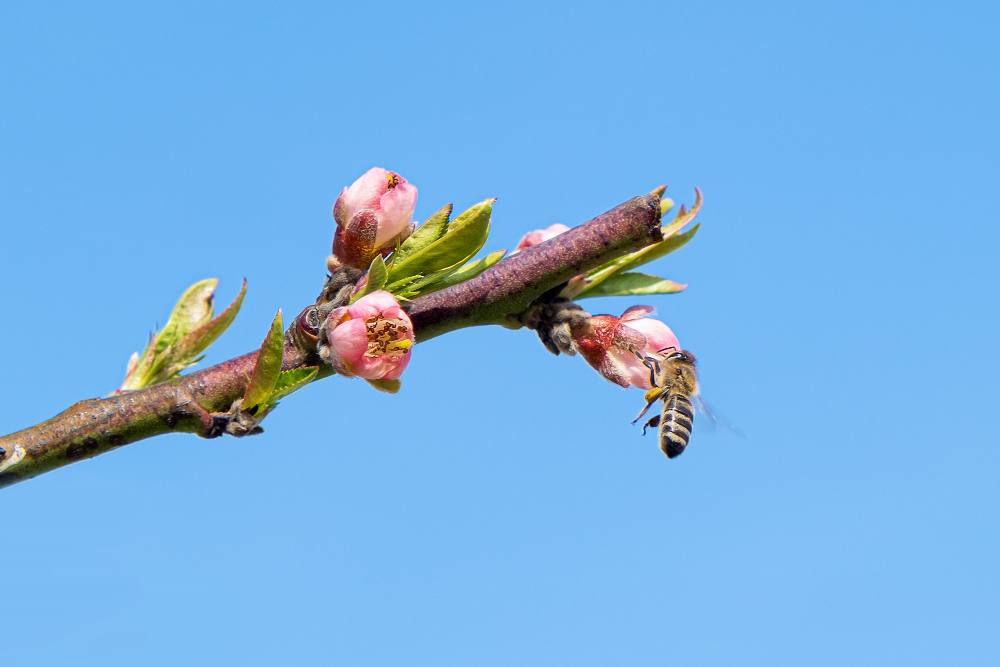
The presence of pollinators in almond cultivation is key to guarantee sustainable and quality crops.



At Manolet Almonds, we want to show you the almond industry from the inside, guided by experts in the sector.
We continue with this series of interviews in which we talk to several scientists from the CEBAS-CISC research center who specialize in different areas related to almond production. Today it is Raquel Sánchez‘s turn, who specializes in the research line of genetic improvement of fruit trees. She has spoken to us in depth about the process of almond sweetening, both historically and today.
Almonds were originally bitter. This is because plants produce bitter, and often toxic, compounds to defend themselves, since plants are sessile organisms. In the case of almonds, the bitter compound is called amygdalin, which belongs to the cyanogenic glycosides. In other words, when a bitter almond is hydrolyzed, it releases glucose, hydrocyanic acid, which is the toxic compound, and benzaldehyde, which is the bitter compound.
The origin of the bitter almond tree, and today the sweet almond tree, is controversial. Through archaeobotany, sites dating back more than 19,000 years have been found, which is where the first almonds originated. These, along with meat and other compounds, were eaten by humans. This occurred mainly in the Middle East. Almonds migrated to the Fertile Crescent, and more than 5,000 years ago, almond remains were found in caves near Israel.
Later, in Egyptian, Greek, and Roman times, almonds were mentioned in different types of texts. For example, in the ancient cities of Memphis and Thebes, traitorous priests were tested using a mixture of almonds. If the almonds were bitter, they would cause death, and it was therefore concluded that the priests were traitors. If the almonds were sweet, they were not traitors and could therefore be spared.
Later, in Greek times, Hippocrates also mentioned almonds for use not only in cooking but also in traditional medicine. Also, in his book Naturalis Historia, Pliny the Elder, in Roman times, talks about almonds, mentioning that the Romans were very proud of having removed the bitterness from almonds. We believe that what they did was boil them, and through this process, the amygdalin broke down, the hydrocyanic acid, which is a gas, evaporated, and the almonds became healthy and wholesome.
In other texts, after Christ, Basil of Caesarea, in Hexameron, comments that almonds, if a pine needle is injected into the base of the tree trunk, could change from bitter to sweet. We are conducting this experiment and it is yielding some very interesting results.
One of the questions we might ask ourselves is why almonds stopped being bitter and became sweet. And although this seems simple, it is not, since it has taken us many years to find out. It is due to a single gene that mutated, and humans, through agriculture, selected the tree that stopped being bitter and became sweet, and thus began its domestication.
Why did almonds stop accumulating amygdalin, even though this compound helped them defend themselves against herbivores? This is due to a mutation in a gene that encodes a transcription factor. Without this mutation, i.e., if it was bitter, this transcription factor could activate the entire pathway and synthesize amygdalin. However, due to this mutation, the transcription factor ceased to be active and was unable to activate the first two genes in the amygdalin synthesis pathway. Therefore, amygdalin could not be synthesized in the seed, and the almond went from being bitter to sweet.
In short, we can say that, over the years, amygdalin ceased to be a compound present in bitter almonds due to a single mutation in a single gene and that humans, through domestication and cultivation, have selected it, resulting in the large number of sweet varieties currently grown in Spanish, European, and international agriculture.
Even today, we still don’t know when or where the almond tree stopped being bitter, since, as we know, and as we have seen at times, bitter almonds still exist. Despite having mutated, this almond tree continued to coexist with the sweet variety, since the almond tree is a plant that has to cross-pollinate.
Bitter almonds are and always will be bitter. This is because a bitter almond tree will only produce bitter almonds, just as a sweet almond tree will only produce sweet almonds. Therefore, the problem of bitter almonds in the Spanish market stems from the source, from the tree. If sweet almonds are mixed with bitter almonds during harvesting, bitter almonds may appear in the final product alongside the sweet ones. This is therefore something that will always be there unless there is greater traceability of those almonds that are sweet and will always remain sweet.
The bitter process is not a process caused by the deterioration or rooting of the almond: it is a process that the plant uses to defend itself and will always be there. Therefore, when it comes to eradicating bitter almonds from the Spanish market, it is as simple as knowing how to choose which trees are sweet.
What solutions could we implement to prevent bitter almonds in sweet almonds in Spain? Well, increasing traceability. As we have mentioned, the trees will continue to be bitter and the sweet ones will continue to be sweet.
If traceability is implemented from the outset, sweet varieties can be diverted for human consumption and bitter varieties to other industries such as those mentioned above, where they have their niche and value, and do not contaminate the sweet varieties, which would be detrimental not only to consumers, but also to those working in the industry and farmers; in short, to society as a whole.
If you prefer to watch the interview in video format, you can find it on our YouTube channel: